
Join the Fusion 2010 Linkedin group to meet people online before and after the conference.


Plenary speakers
Andrew Blake - Tuesday 27 July at 9:00
 |
Read Andrew's abstract |
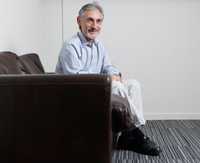 Andrew Blake is Deputy Managing Director at the Microsoft Research laboratory in Cambridge, where he also leads the Machine Learning and Perception Group (MLP) with Prof. Christopher Bishop.
Prior to joining Microsoft he trained in mathematics and electrical engineering in Cambridge England, and studied for a doctorate in Artificial Intelligence in Edinburgh. He was an academic for 18 years, latterly on the faculty at Oxford University, where he was a pioneer in the development of the theory and algorithms that can make it possible for computers to behave as seeing machines. In 1999 he moved to Microsoft Research Cambridge to lead research in Computer Vision.
He has published several books including "Visual Reconstruction" with A. Zisserman (MIT press), "Active Vision" with A. Yuille (MIT Press) and "Active Contours" with M. Isard (Springer-Verlag). He has twice won the prize of the European Conference on Computer Vision, with R. Cipolla in 1992 and with M. Isard in 1996, and was awarded the IEEE David Marr Prize (jointly with K. Toyama) in 2001. In 2006 the Royal Academy of Engineering awarded him its Silver Medal and in 2007 the Institution of Engineering and Technology presented him with the Mountbatten Medal (previously awarded to computer pioneers Maurice Wilks and Tim Berners-Lee, amongst others.) He was elected Fellow of the Royal Academy of Engineering in 1998, Fellow of the IEEE in 2008, and Fellow of the Royal Society in 2005.
The vision team at Microsoft has developed principles and built innovative product software for image editing and video processing. They have developed stereoscopic cameras that incorporate a sense of depth for use in video communication (the i2i project), and for remote collaboration (the C-Slate project). More recently work has started on processing other forms of imaging, collaborating with the MRRC in the University of Cambridge to improve MRI imaging using probabilistic inference. Also a new effort has been started in Cambridge working on medical imaging, feeding image processing innovation into the Microsoft Amalga family of Enterprise Health Systems .
Paul Newman - Thursday 29 July at 9:00
|
Read Paul's abstract |
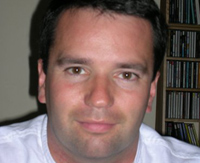
Paul Newman is an IEEE member and a European Distinguished Lecturer of the IEEE Robots and Automation Society (RAS) for 2009. He heads the Mobile Robotics Group (MRG) at the University of Oxford, Oxford, UK, and has research interests in pretty much anything to do with autonomous navigation but particularly Simultaneous Localisation and Mapping.
Paul Newman obtained an M.Eng. in Engineering Science from Oxford University in 1995. He then undertook a Ph.D. in autonomous navigation at the Australian Center for Field Robotics, University of Sydney, Australia. In 1999 he returned to the UK to work in the commercial sub-sea navigation industry.
In late 2000, he joined the Dept of Ocean Engineering at M.I.T., where as a post-doc and later a research scientist, he worked on algorithms and software for robust autonomous navigation for both land and sub-sea agents. In early 2003 he returned to Oxford as a Departmental Lecturer in Engineering Science before being appointed to a University Lectureship in Information Engineering and becoming a Fellow of New College, Oxford, in 2005.
He is on the editorial board of the International Journal of Robotics Research and The Journal of Field Robotics. In 2008 he became a Reader in Engineering Science and he is also a tutorial fellow in Engineering at New College, Oxford.
Uncertainty forum speakers
Wednesday 28 July at 9:00
Over the past 3 years, information fusion has expanded from handling physical sensors to handling all sensors/sources of information and from tracking physical targets to tracking all targets, including physical, informational, cognitive and sociological targets. In this context, tracking often needs reinterpretation as identity management and the previous closed-world framework often needs replacement by an open-world framework. In this process, apparent limitations of classical probability theory to uncertainty have been noted, including the conventional orientation of probability theory toward characteristics of things known to exist rather than toward existence itself. In some cases, the limitations have been shown to be due not to the underlying theory but to the application of the theory. In other cases, the question is still open. The Uncertainty Forum includes 5 participants representing Bayesian methods, Dempster-Shafer Theory, Dezert-Smarandache Theory, Transferable Belief Model and human intelligence/processing. Motivated by an example about a threat of a vehicle-born IED (VBIED), representatives of these 5 approaches to representation of uncertainty will discuss the guidance that each approach gives for 1) fusion of currently available information and 2) active but minimalistic solicitation of additional information. The goal of the Uncertainty Forum is not to come to specific conclusions about a linear or other ranking of approaches for representing uncertainty but rather to widen the spectrum of available options and link these options with situations in which they perform well.
Forum organisers
Simon Maskell had an IEE scholarship to Cambridge University Engineering Department, from where he graduated with distinction. He received his PhD after a UK MoD fellowship which ran concurrently with a Royal Commission of 1851 Industrial Fellowship. Simon now leads projects at QinetiQ on developing state-of-the-art Bayesian algorithms for tracking, data fusion, intelligence processing and video processing. These projects have specifically investigated Bayesian interpretations of alternative methods for handling the imprecise, conflicting and ambiguous information that is encountered when fusing hard and soft data. Simon wrote the Wiley Encyclopaedia of Computer Science definition of “Tracking” and is general chair for Fusion 2010.
John Lavery is a Senior Program Manager in the Mathematical Sciences Division of the Army Research Office, where he manages a program in information fusion, urban terrain modeling and related areas and carries out research on urban terrain modeling. Dr. Lavery is currently leading various U.S. Army initiatives in fusion, including fusion of hard (physics-based) and soft (human-source) information and fusion for detection of social networks.
Forum speakers
Jean Dezert is a research scientist at the French Aerospace Lab and does research in tracking and information fusion. During 1991-1992, he visited the Department of Electrical and Systems Engineering, University of Connecticut, USA as a European Space Agency Postdoctoral Research Fellow. Since 2001, his main activity has been focused on the development and applications of DSmT (Dezert-Smarandache Theory) for information fusion. Since 2004, he has edited three textbooks (collected works) with Professor Florentin Smarandache. He has given seminars, invited lectures and tutorials in America, Europe, Australia and China. He has been involved in the International Society of Information Fusion (ISIF) since 1998, served as Local Arrangements Organizer for the Fusion 2000 Conference in Paris, has been a member of the Technical Program Committees of the annual Fusion conferences from 2001 to 2010 and served as executive vice-president of ISIF in 2004. His new research interest is multi-criteria decision-making support based on belief functions.
Peter Gill is Honorary Fellow at the University of Liverpool, UK. He is the author of Policing Politics (1994) and Rounding Up the Usual Suspects? (2000), co-author of Intelligence in an Insecure World (2006) and co-editor of the PSI Handbook of Global Security and Intelligence: National Approaches (2008) and Intelligence Theory: Key Questions and Debates (2009). His current work is concerned with the democratic organization and control of intelligence in both ‘old’ and ‘new’ democracies. Prof. Gill speaks at numerous seminars.
Simon Godsill is Professor of Statistical Signal Processing in the Engineering Department at Cambridge University. He specializes in Bayesian computational methodology, multiple object tracking, audio and music processing, and financial time series modeling. Prof. Godsill has served as Associate Editor for IEEE Tr. Signal Processing and the journal Bayesian Analysis. He was Theme Leader in Tracking and Reasoning over Time for the UK’s Data and Information Fusion Defence Technology Centre (DIF-DTC) and Principal Investigator on many grants funded by the EU, EPSRC, QinetiQ, MOD, Microsoft UK, Citibank and Mastercard.
Arnaud Martin received a Master’s degree in probability (1998) and a PhD degree in signal processing (2001) from the University of Rennes and his “Habilitation à Diriger des Recherches (HDR)” from the Université de Bretagne Occidentale (2009). Dr. Arnaud Martin worked on speech recognition during three years (1998-2001) at France Telecom R&D. In 2008, he visited the Decision Support Systems section of Defence R&D Canada – Valcartier. His research interests are mainly related to belief functions for classification and data fusion, topics on which he has given invited seminars and lectures. In 2010, Arnaud organized a workshop on belief functions held at Brest and created the Belief Functions and Applications Society for this event.
David Mercier graduated in 2003 with a DEA (equivalent of a MS) in artificial intelligence from the University Paul Sabatier (UPS) of Toulouse, France and earned a PhD from the University of Technology of Compiègne (UTC), France in 2006. He is currently an associate professor at the University of Artois, France. His research interests include information fusion and reasoning with uncertainty, in particular with belief functions.